
Home > Steel Products > Steel Plates > Stainless Steel Plates > 304L Stainless Steel Plates

304L Stainless Steel Plates

Buy Top Quality 304L stainless steel plate at Ferrite Structural Steels Pvt Ltd. – India’s Leading Supplier, Manufacturer and Exporter of Stainless Steel Plates.
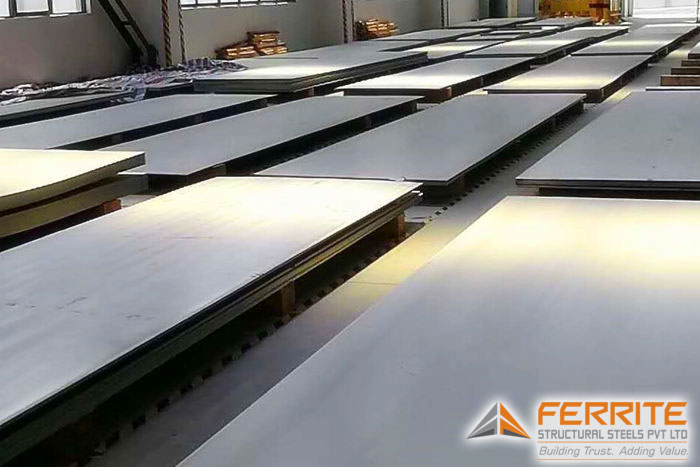
304L Stainless Steel Plates

304L stainless steel plates are a lower-carbon variant of the classic 304 stainless steel, which is the most widely used stainless steel grade. The “L” in 304L stands for “low carbon,” which makes this grade less prone to carbide precipitation due to welding. This feature enhances the weldability of the 304L plates, making them ideal for use in applications where welding is necessary without undergoing post-weld heat treatments.

The exceptional corrosion resistance and ease of fabrication make 304L stainless steel plates popular across a wide array of industries. They are extensively used in the food and beverage industry for processing equipment and storage tanks, providing resistance to common acids and chemicals while maintaining non-toxic and hygienic surfaces. In addition, their resistance to atmospheric corrosion makes them suitable for architectural and outdoor applications, including railings, trim, and building facades. 

Ferrite Structural Steels Pvt Ltd., as a major manufacturer and supplier, offers high-quality 304L stainless steel plates that meet these diverse application needs. Our 304L plates are praised for their durability and performance, ensuring that they can handle rigorous industrial conditions with ease. At Ferrite Structural Steels, we are dedicated to providing solutions that not only meet but exceed the requirements of modern industries, ensuring our materials contribute to the success and efficiency of your projects. Whether your needs are for complex industrial applications, architectural aesthetics, or food safety, our 304 in stainless steel plates offer the reliability and quality you need.

304L stainless steel plate Specifications

Product Name 304L stainless steel plates
Brand Ferrite Structural Steels Pvt. Ltd.
Minimum Order Quantity 1 Ton
Material Stainless steel
Finish Galvanized, Hot-rolled or Cold-rolled

304L stainless steel plate Size Chart

Plate thickness (mm) Weight (kg/m) kg/meter (width 1200mm) kg/meter (width 1500mm) kg/meter (width 1800mm) kg/meter (width 2400mm)
3 23.55 28.3 35.3 42.4 56.5
4 31.4 37.7 47.1 56.5 75.4
5 39.25 47.1 58.9 70.7 94.2
6 47.1 56.5 70.7 84.8 113
8 62.8 75.4 94.2 113 150.7
10 78.5 94 118 141 188
12 94.2 113 141 170 226
16 125.6 151 188 226 301
20 157 188 236 283 377
22 172.7 207 259 311 415
25 196.25 236 294 353 471
28 219.8 264 330 396 528
32 251.2 301 377 452 603
36 282.6 339 424 509 678
40 314 377 471 565 754
45 353.25 424 530 636 848
50 392.5 471 589 707 942
55 431.75 518 648 777 1036
60 471 565 707 848 1130
65 510 612 765 918 1224
70 549.5 659 824 989 1319
75 588.75 707 883 1060 1413
80 628 754 942 1130 1507
90 706.5 848 1060 1272 1696
100 785 942 1178 1413 1884


SS304L Equivalent Grades

STANDARD WERKSTOFF NR. UNS JIS BS GOST AFNOR EN
SS 304L 1.4306 / 1.4307 S30403 SUS 304L 3304S11 03Х18Н11 Z3CN18‐10 X2CrNi18-9 / X2CrNi19-11


Chemical Composition of 304L Stainless Steel

Grade C Mn Si P S Cr Mo Ni N
SS 304L 0.035 max 2 max 1.0 max 0.045 max 0.03 max 18 – 20 8 – 13


304L Stainless Steel Mechanical Properties

Density Melting Point Tensile Strength Yield Strength (0.2%Offset) Elongation
8.0 g/cm3 1400 °C (2550 °F) Psi – 75000 , MPa – 515 Psi – 30000 , MPa – 205 35 %

Key Features and Benefits

  1. Reduced Carbon Content: The lower carbon content in 304L helps minimize carbide precipitation during welding, preserving the corrosion resistance of the weld area.
  2. Excellent Corrosion Resistance: 304L stainless steel offers great resistance to a wide variety of chemical corrodents, including industrial atmospheres and particularly environments with higher chloride levels.
  3. Good Weldability and Formability: The reduction in carbon makes it more weldable and formable compared to standard 304 stainless steel, accommodating more complex fabrications.
  4. High Durability: It maintains excellent toughness, even down to cryogenic temperatures, which is somewhat uncommon in other stainless steel grades.
  5. Non-Magnetic: In its annealed condition, 304L typically shows very little magnetic properties and is easy to use in applications where magnetism can be a problem.
  6. Hygiene and Cleanability: Like other austenitic stainless steels, 304L can be sanitized easily, making it a top choice for industries requiring stringent hygiene conditions such as food processing, kitchens, and hospitals.
  7. Longevity: With its resistance to high temperatures and corrosion, 304L stainless steel plates offer a longer service life, reducing the need for frequent replacements.
  8. Sustainability: Stainless steel is 100% recyclable, and the durability of 304L helps contribute to environmental sustainability by minimizing waste.

Applications of 304L stainless steel plate

Food Industry

  • Kitchen Equipment: Widely used in the manufacture of kitchen appliances, cookware, and utensils due to its non-reactive properties.
  • Food Processing Equipment: Essential for food processing plants, including worktables, sinks, and other surfaces that come into contact with food, where sanitation and easy cleaning are crucial.

Medical Industry

  • Surgical Instruments: 304L stainless steel is used to make surgical tools and medical equipment that require frequent sterilization.
  • Hospital Infrastructure: Employed in the construction of countertops, cabinets, and other fixtures within hospitals due to its hygienic properties.

Construction and Architecture

  • Architectural Paneling and Trim: Its aesthetic appearance and corrosion resistance make it a popular choice for exterior cladding, paneling, and decorative trim in buildings.
  • Fixtures and Railings: Used in the fabrication of railings, door fixtures, and other architectural details where longevity and appearance are important.

Automotive and Aerospace

  • Automotive Trim: Commonly used in car trims and decorative parts due to its shiny, rust-resistant finish.
  • Aerospace Components: Applied in the production of non-critical parts in the aerospace industry due to its strength and resistance properties.

General Manufacturing

  • Storage Tanks and Containers: 304L stainless steel is used for liquid storage tanks and chemical containers because of its resistance to corrosion.
  • Machine Parts: Suitable for various non-contact parts in machinery, especially in environments where corrosion resistance is a priority.
FAQs — 304L Stainless Steel Plates

304L Stainless Steel Plates: Frequently Asked Questions

Straight answers on sizes, thickness, weight, grades, MTC, pricing and ordering — so your enquiry is specification-ready before you send it.

01
What is 304L stainless steel plate?
304L plate is an austenitic chromium-nickel stainless steel supplied as flat plate for welded vessels, food-processing equipment, tanks and fabricated components. The “L” suffix indicates a controlled low-carbon grade; it is part of the ordered designation and must appear consistently on the PO and MTC. The grade name alone does not define dimensions, finish, tolerances, delivery condition or inspection. State the complete product standard and purchase specification when requesting a quotation.
02
Which standard should be specified for 304L stainless steel plate?
The purchase order should state ASTM A240/A240M or the project-specified standard, including the applicable edition and any project amendments. Also identify product form, grade designation, dimensions, finish, tolerances, heat treatment, testing and documentation. A grade designation and a dimensional or finish requirement perform different functions and should not be combined or assumed.
03
How does 304L plate compare with 304 plate?
304L and 304 belong to the same grade family, but the carbon limits and potentially applicable requirements differ. The low-carbon designation can be important for welding, while the standard grade may be acceptable for other conditions. Do not substitute either way without comparing the applicable standard, MTC, fabrication route and end-user approval.
04
Is 304L stainless steel plate suitable for general corrosion-resistant service?
It may be considered for general corrosion-resistant service, but suitability depends on the actual temperature, chemicals, chlorides, stress, exposure time, fabrication, surface condition and cleaning. A generic application list is not a material-selection approval. Follow the equipment code, approved drawing and responsible materials or corrosion engineer’s decision.
05
Can 304L stainless steel plate be welded?
304L is commonly fabricated by welding, subject to the approved WPS, suitable consumables, joint design, heat input and cleanliness controls. Prevent carbon-steel contamination and restore the specified surface condition after fabrication. Pressure, high-temperature and safety-critical joints require qualified procedures, personnel and the responsible engineer’s approval.
06
What chemical and mechanical requirements should be checked for 304L plate?
Check the chemistry limits, tensile and yield requirements, elongation, hardness where applicable, heat-treatment condition and thickness-dependent provisions in the governing standard. For elevated-temperature design, room-temperature values alone are insufficient. The MTC and project specification should be reviewed against the ordered thickness and intended service.
07
Can 304L plate replace another stainless steel grade?
Not automatically. Similar appearance or membership of the 300 series does not prove equivalence. Alloy content, carbon limit, corrosion behaviour, temperature capability, mechanical requirements and code acceptance can differ. Submit a documented comparison and proposed MTC for end-user or responsible engineer approval before purchasing or fabrication.
08
Which industries commonly enquire for 304L stainless steel plate?
Enquiries commonly relate to welded vessels, food-processing equipment, tanks and fabricated components. These examples are purchasing context, not a performance guarantee. Buyers should provide the process environment, design temperature, fabrication drawing, finish, inspection plan and governing code so the requirement can be reviewed against the requested specification.
09
What sizes and thicknesses are available for 304L Stainless Steel Plates?
Size availability should be confirmed for the exact grade, thickness, width, length, finish and quantity. Provide finished dimensions and any cutting allowance separately. A listed size range should not be treated as ready stock, particularly for less common thickness-finish combinations or low-carbon grade variants.
10
How is the weight of 304L Stainless Steel Plates calculated?
Estimated plate weight equals length × width × thickness × material density, with units converted consistently. Austenitic stainless steel is often budgeted using a nominal density close to 8,000 kg/m³, but the grade-specific density and supplier’s confirmed theoretical or actual-weight basis should control purchasing, freight and invoicing.
11
Is a size chart or weight chart available for 304L Stainless Steel Plates?
A size or weight chart can support preliminary budgeting, but it must be checked against the selected grade, density and actual ordered dimensions. For cut pieces, confirm whether the quotation covers theoretical finished weight, actual dispatch weight or gross mother-plate utilisation, including any chargeable offcut.
12
What is the current price per kg of 304L Stainless Steel Plates?
A fixed current price per kg should not be published because stainless-steel values change with alloy surcharge, grade, thickness, finish, quantity, source, testing, processing and freight. Request a dated quotation with complete specifications and delivery postcode. Confirm validity, GST, cutting, packing and transport terms.
13
How is the price per tonne for 304L Stainless Steel Plates determined?
Price per tonne reflects the selected grade, current raw-material market, dimensions, finish, quantity, source, MTC, inspection, cutting, packing and logistics. Provide piece count and total tonnage. Confirm whether billing is based on theoretical or actual weight and whether processing scrap or mother-plate utilisation is included.
14
What is the MOQ for 304L Stainless Steel Plates?
MOQ should be confirmed for the exact grade, thickness, finish, dimensions and quantity. Less common sizes or finishes may have a different commercial minimum. Provide piece quantity and total tonnage at enquiry stage; do not assume the same MOQ applies to every stainless-steel plate variant.
15
Can stock availability of 304L Stainless Steel Plates be confirmed before ordering?
Yes. Availability should be confirmed against the exact grade, standard, thickness, width, length, finish, make preference and quantity. Do not assume every listed size is ready stock. Ask the supplier to identify available material, heat traceability, documentation status and any processing needed before dispatch.
16
Can an MTC be requested with 304L Stainless Steel Plates?
Request the MTC at enquiry stage and specify the required EN 10204 document type or project format. Check the grade, product standard, heat number, chemistry, mechanical results and heat-treatment condition. Documentation must match the offered material before fabrication, tender approval or export dispatch.
17
Can third-party inspection be arranged for 304L Stainless Steel Plates?
Third-party inspection can be reviewed when the agency, inspection and test plan, witness or hold points, acceptance criteria and document format are stated before quotation. Scope, access, charges and schedule must be agreed in the purchase order. Do not assume inspection is included in the base plate price.
18
Can 304L Stainless Steel Plates be cut, drilled or fabricated to a drawing?
Processing requirements can be reviewed against the controlled drawing, grade, thickness, finish, tolerances and quantity. Show finished dimensions, holes, bevels, bends, welds and inspection points. Critical fabrication must follow the approved code, drawing, qualified procedure and responsible engineer’s approval.
19
Does Ferrite supply 304L Stainless Steel Plates in Mumbai, Navi Mumbai and Maharashtra?
Ferrite Structural Steels Pvt Ltd has sales operations in Mumbai and a location in Kalamboli, Navi Mumbai. Buyers in Mumbai, Navi Mumbai, Maharashtra and nearby states should provide the delivery postcode, unloading constraints and required date. Availability, freight and dispatch arrangements must be confirmed for the specified order.
20
Can India-wide and export buyers request quotations for 304L Stainless Steel Plates?
India-wide and export requirements can be reviewed based on specification, quantity and destination. Domestic buyers should provide the delivery postcode. Export enquiries should state destination port, Incoterm, packing, documentation, inspection scope and shipment quantity. Availability and commercial terms must be confirmed before order placement.

Why Choose Ferrite’s 304L stainless steel plate?

Choosing Ferrite Structural Steels Pvt Ltd. for your 304L stainless steel plates ensures you receive products of the highest quality, backed by our dedication to excellence and customer satisfaction. Our 304L stainless steel plates are manufactured using advanced processes, ensuring superior strength, durability, and reliability for a wide range of applications. We offer an extensive selection of sizes and thicknesses to meet your specific needs, all at competitive prices. Whether you’re in construction, automotive, shipbuilding, or any other industry, Ferrite’s 304L stainless steel plates provide the robust performance and longevity you require. Experience the Ferrite difference today—request a quote and let us provide you with the perfect 304L stainless steel plate solution for your project.

Send Enquiry