
Home > Steel Products > Steel Pipes
Buy High-Quality Steel Pipes at Ferrite Structural Steels Pvt Ltd. – India’s Leading Supplier, Manufacturer, Distributor and Exporter of Steel Products.
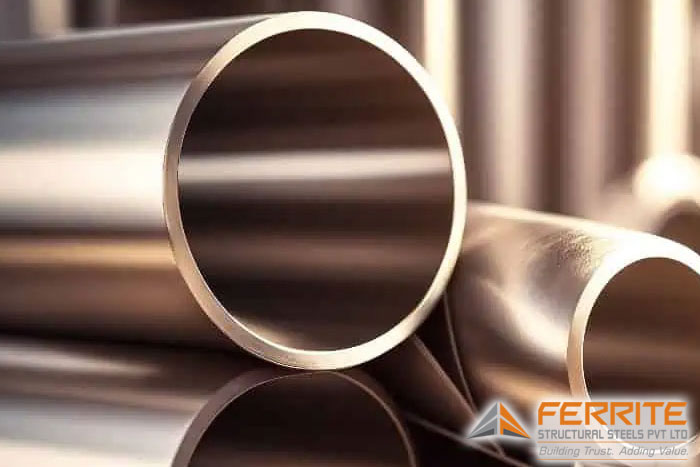
Steel pipes are a fundamental component widely utilized across various industries due to their durability, versatility, and high tensile strength. These pipes serve as the backbone in sectors such as construction, manufacturing, and transportation, playing a crucial role in applications ranging from plumbing and HVAC systems to oil and gas pipelines. The increasing reliance on steel pipes for infrastructure projects and new technological advancements in metallurgy further underscore their popularity and essential status in industrial applications.
Ferrite Structural Steels Pvt Ltd. stands out as a leading supplier, manufacturer, and exporter of steel products, including steel pipes. With a commitment to quality and innovation, Ferrite Structural Steels Pvt Ltd. caters to a broad range of industry needs, ensuring reliability and performance through their extensive product offerings. Their steel pipes are crafted to meet the highest standards, making them a preferred choice for businesses looking to support robust construction and efficient operations.
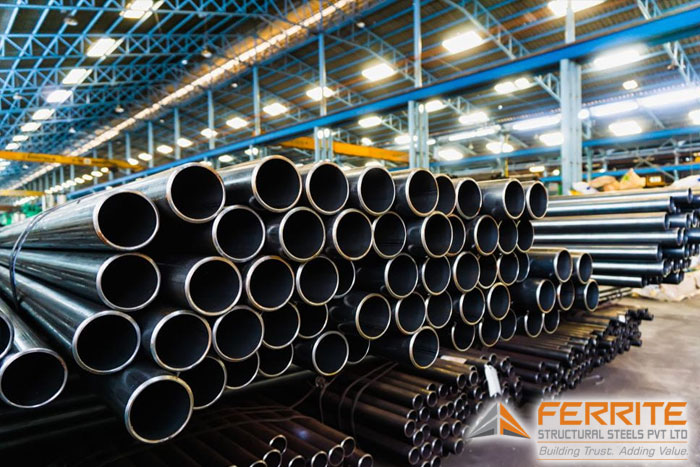
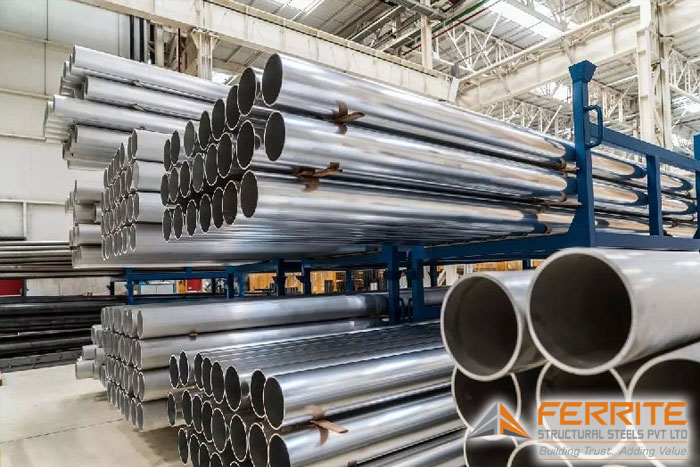
Ferrite Structural Steels Pvt Ltd. offers a variety of steel pipes in several standards and grades, catering to diverse industry requirements. Among the most common and widely used grades in our inventory are SS 304 and SS 316, available in both square and round configurations. The SS 304 grade, known for its excellent corrosion resistance and durability, is suitable for a wide range of applications, making it a staple in industries such as food processing and architecture. Similarly, the SS 316 grade offers enhanced corrosion resistance, especially against chlorides and other industrial solvents, making it ideal for more demanding environments such as marine applications and chemical processing. These grades ensure that our customers receive the highest quality steel pipes, tailored to withstand various operational conditions while maintaining longevity and structural integrity.
| Product Name | Steel Pipes |
| Brand | Ferrite Steels |
| Minimum Order Quantity | 1 Ton |
| Material | Mild Steel and Stainless Steel |
| Standards/Grades | SS 304, SS 316 for Stainless Steel; Schedule 40, Schedule 80 for Mild Steel |
| Available sizes | Lengths: 6m, 30m, 12m, 3m |
| Thickness (mm) | Varies by schedule; e.g., 2.11 mm, 3.05 mm, 4.50 mm, etc. |
| Finish | Hot Rolled, Galvanized, Polished |
1. What is a steel plate?
A steel plate is a flat-rolled steel product supplied in a specified material, grade, thickness, width and length. It is generally used where heavier sections, structural strength, wear resistance, pressure containment or industrial fabrication capability are required.
Steel plates are commonly used in buildings, bridges, tanks, machinery, mining equipment, platforms, pressure vessels and heavy engineering.
2. Which types of steel plates does Ferrite manufacture and supply?
Ferrite’s published range includes mild steel, stainless steel, carbon steel, hot-rolled, boiler-quality, high-tensile, abrasion-resistant and chequered plates.
Each plate family has different grades, mechanical properties, thickness ranges and applications. Availability should therefore be confirmed against the complete specification rather than only the words “steel plate.”
3. What is the difference between a steel sheet and a steel plate?
Both are flat-rolled steel products, but “sheet” generally refers to relatively thinner material, while “plate” is commonly used for heavier structural and industrial sections.
The exact distinction can vary by standard and commercial practice. To prevent confusion, specify the actual grade, thickness, width, length and applicable standard in the enquiry.
4. What is the difference between mild steel, carbon steel and stainless steel plates?
Mild steel plate is a low-carbon steel commonly selected for structural fabrication, machinery, frames and general engineering.
Carbon steel covers a wider family of steels in which carbon content and other properties vary by grade. Stainless steel contains sufficient chromium to form a corrosion-resistant passive surface and is selected for hygienic, chemical, marine or corrosion-sensitive environments. Ferrite publishes separate MS, carbon steel and stainless steel plate categories.
5. What is the difference between structural, high-tensile, boiler-quality and abrasion-resistant plates?
Structural plates are used for load-bearing fabrication and general engineering.
High-tensile plates provide higher yield or tensile strength for demanding structural applications. Boiler-quality plates are specified for approved pressure and temperature service. Abrasion-resistant plates are selected for wear applications such as liners, chutes, buckets and material-handling equipment.
6. Which structural steel plate grades can Ferrite supply?
Ferrite’s published plate range includes grades such as:
IS 2062 E250A
IS 2062 E250 BR
IS 2062 E250 BO
IS 2062 E350 variants
IS 2062 E450 variants
ASTM A36
S235JR
S275JR
S355J2
EN8
C45
The exact grade must be confirmed for the required thickness, dimensions, test requirements and application.
7. Which stainless steel plate grades are available?
Ferrite’s published stainless steel plate range includes 304, 304L, 310, 310L, 316 and 316L.
SS 304 is widely used for general corrosion-resistant applications. SS 316 is commonly considered where improved resistance to chlorides or more aggressive environments is required, while SS 310 is associated with selected elevated-temperature applications. Final grade selection should follow the project specification.
8. What steel-plate sizes and thicknesses can Ferrite supply?
Ferrite’s MS and stainless steel plate pages publish selected thicknesses from 3–100 mm and widths of 1,200, 1,500, 1,800 and 2,400 mm. Its carbon steel plate page lists thicknesses from 3–25 mm, widths from 1,000–3,000 mm and lengths from 2,000–10,000 mm.
Not every thickness, width, length and grade is available in every plate type. Submit the exact requirement for confirmation.
9. What information should I provide for an accurate steel-plate quotation?
Provide:
Plate type
Material grade
Applicable standard
Thickness
Width and length
Required quantity or tonnage
Surface condition or coating
Approved mill or make
MTC and traceability requirements
Additional testing or inspection
Cutting or fabrication requirements
Delivery location
Required delivery date
BOQ or drawing
Complete specifications help prevent pricing the wrong grade, plate type or processing scope.
10. How is steel-plate weight calculated?
Theoretical plate weight is calculated from:
Thickness × width × length × material density
For ordinary carbon or mild steel, a density of approximately 7,850 kg/m³ is commonly used for estimation. The final commercial weight should follow the dimensions, applicable tolerances and agreed weighment basis.
11. How much does a steel plate weigh per square metre?
The weight per square metre depends mainly on the plate thickness and material density.
For example, a thicker plate weighs proportionally more per square metre than a thinner plate of the same material. Send the grade, thickness, width and length, and Ferrite can prepare a theoretical weight estimate for quotation.
12. How can I get the current steel-plate price per kg?
Send the plate type, grade, thickness, dimensions, quantity, mill preference, processing requirement and delivery location.
Steel-plate prices change with the grade, thickness, mill source, plate size, testing, cutting, market conditions and freight. A dated specification-based quotation is more reliable than a general online price range.
13. Are steel plates quoted by kilogram, tonne, piece or complete plate?
Steel plates may be quoted by kilogram, metric tonne, piece or complete plate.
The quotation should clearly state:
Rate basis
Theoretical or actual weight
Plate dimensions
Cutting and processing charges
Testing and inspection charges
Taxes
Loading
Freight
Unloading responsibility
This allows the buyer to compare the complete landed cost.
14. What is the minimum order quantity for steel plates?
Ferrite currently publishes a minimum order quantity of 1 tonne on its parent Steel Plates page and several specialty plate pages.
Smaller requirements may be considered from available stock. Custom grades, special dimensions, mill-specific material or fresh production may require a different minimum quantity.
15. Are steel plates supplied with a Material Test Certificate?
MTC and traceability requirements should be stated before order confirmation.
The enquiry should mention the required grade, standard, heat or plate number, chemical and mechanical test results, impact testing, hardness testing or any third-party inspection requirement. Ferrite should confirm the exact documentation included in its quotation.
16. Can Ferrite supply plates from approved Indian steel mills?
Ferrite’s plate pages publish makes including SAIL, RINL, Jindal, Tata, Pushpak, Mamaya, Mahavir, SKS and Balbir across selected product ranges.
Send the project-approved make list with the plate type, grade, thickness and quantity. The confirmed mill, MTC, origin and permitted alternatives should be recorded in the quotation and purchase order.
17. Can steel plates be supplied in custom sizes or cut-to-size form?
Yes. Ferrite publishes customised structural-steel production and cut-to-size capability through its manufacturing and engineering facilities.
Provide the plate grade, thickness, finished width, finished length, cutting tolerance, quantity and edge requirement. Feasibility depends on plate availability, cutting method and commercial quantity.
18. Do you provide plate cutting, drilling, welding or fabrication?
Ferrite’s services include structural-steel fabrication, welded engineering assemblies and requirement-based customisation.
Cutting, drilling, bevel preparation, hole-making, bending, welding or fabricated-plate assemblies should be reviewed against the approved drawing. The exact processing scope, tolerance, inspection and lead time must be confirmed in the quotation.
19. Which steel plate is suitable for my application?
Selection depends on the actual service:
Buildings, bridges and structural fabrication: approved structural or MS plate grade
Heavy machinery and higher-strength structures: high-tensile plate
Chutes, buckets and wear liners: abrasion-resistant plate
Boilers and pressure vessels: approved boiler or pressure-vessel grade
Food, chemical and marine equipment: suitable stainless steel grade
Industrial floors and walkways: chequered plate
General machinery and fabrication: MS, carbon steel or hot-rolled plate
Ferrite can help identify commercially available options, but final grade, thickness, pressure rating, hardness and structural suitability should remain with the authorised engineer.
20. Do you supply steel plates in Mumbai, Navi Mumbai and other regions?
Ferrite operates from its sales office in Ghatkopar East, Mumbai, and its factory and stock location at KWC Kalamboli in the Navi Mumbai region.
Steel-plate requirements can be evaluated for Mumbai, Navi Mumbai, Thane and industrial locations across Maharashtra. Regional dispatch depends on plate dimensions, total weight, vehicle capacity, route restrictions and unloading arrangements.
Ferrite Structural Steels Pvt. Ltd. manufactures and supplies steel pipes for construction, structural fabrication, machinery, water systems, industrial piping and corrosion-sensitive applications.
Our range includes mild steel, stainless steel, ERW, seamless, galvanised, round, square and rectangular pipes in standard and requirement-based grades, sizes, wall thicknesses and lengths.
Steel Pipes Supplied to Your Specification
Ferrite supports contractors, fabricators, manufacturers and procurement teams with:
Technical and Commercial Support
Send your BOQ, piping specification or fabrication drawing for review. Our team can help confirm available grades, dimensions, schedules, wall thicknesses, theoretical weight, documentation and delivery requirements.
Final pressure rating, corrosion suitability and structural selection should follow the approved project specification and remain subject to the authorised engineer or piping consultant.
Request a Steel-Pipe Quote
Share the pipe material, grade, shape, manufacturing route, NB/NPS or outside dimensions, wall thickness or schedule, length, quantity and delivery location. Ferrite will review availability, processing scope, documentation and delivery terms before preparing a requirement-based quotation.