Straight answers on sizes, thickness, weight, grades, MTC, pricing and ordering — so your enquiry is specification-ready before you send it.
01
What is a steel joist and what does it support?
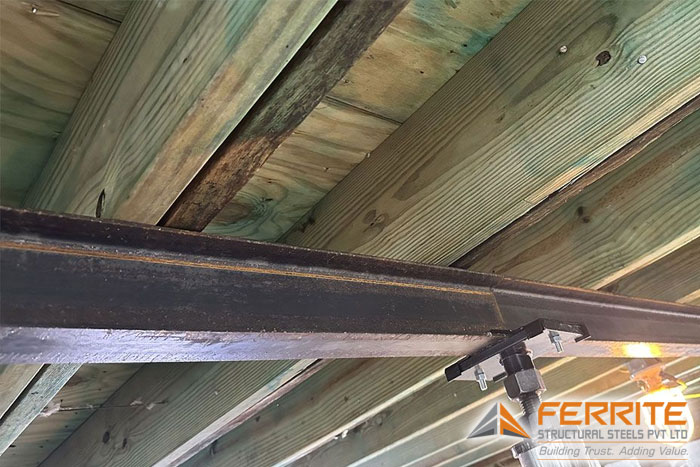
Joist refers to a horizontal member used as part of an engineered floor, roof or ceiling system. It is used in floor, roof and ceiling systems, decks, platforms, renovations and mechanical supports. For structural work, the exact section, material grade, standard and connection detail must follow the approved drawings and calculations; a product-family name does not establish a safe load.
02
How is a joist different from a main structural beam?
A joist is normally a secondary horizontal member supporting a floor, roof or ceiling system and transferring load to primary beams, walls or girders. Its spacing, span and restraint are design decisions. Do not treat a general beam and a joist as interchangeable without approved structural calculations.
03
Which geometric details distinguish one joist section from another?
Joist must be compared using the actual geometry and section properties, not only the familiar “I” or “H” label. Flange width, flange thickness, web thickness, root radius and unit mass influence behaviour. The approved section designation and orientation must control procurement.
04
What joist sizes are listed on the Ferrite page?
The live page lists 150 x 75 x 5 mm to 600 x 210 x 12 mm for Joist. Treat this as a catalogue range rather than proof that every combination is ready stock. Send the exact designation, grade, length and quantity so the required section can be checked against the applicable table and current availability.
05
How should joist spacing and span be decided?
Joist spacing and span must be determined by structural design using applied loads, deflection limits, restraint, decking action, vibration, fire requirements and connection details. A supplier’s size chart cannot replace calculations. Order only after the responsible engineer approves the joist schedule and drawings.
06
Can a joist be selected only from floor area?
Floor area alone cannot determine a joist section. Load intensity, load pattern, span, spacing, lateral restraint, deflection, vibration, openings, fire design and connections all matter. Final selection must follow an approved joist schedule and calculations prepared by the responsible structural engineer.
07
What sectional weights are shown for joists?
Published weight per metre is a section-identification and quantity-estimation aid. Confirm it for the exact section table and standard. Total theoretical weight equals unit mass multiplied by ordered length and piece count; commercial settlement may use actual or theoretical weight as expressly stated in the quotation.
08
Are holes or service openings permitted in a joist?
Service holes, notches or openings must never be assumed permissible. Their location and reinforcement can materially affect shear, bending and stability. Submit the coordinated services drawing to the structural engineer and fabricator, and proceed only with approved details and fabrication drawings.
09
How is the Joist price per kg calculated?
A fixed current Joist price per kg should not be published because steel input cost, grade, section mass, quantity, length, finish and market date change. Provide the exact section, standard, total tonnage and delivery postcode for a dated quotation, and confirm GST, freight and fabrication inclusions.
10
How can a buyer request a dated Joist tonne rate?
Yes, Joist can be requested on a dated per-tonne basis for a defined specification. State the section, grade, standards, length, quantity, finish, MTC, inspection and destination. Compare quotations on the same weight basis, tax, freight, cutting and documentation terms.
11
Why may two Joist quotations differ?
The landed cost of Joist depends on base steel price, grade, unit mass, size availability, order mix, length, cutting, drilling, finish, testing, inspection, packing and transport. Mixed or uncommon sections may have different conversion and logistics costs from a repetitive bulk order.
12
What minimum order quantity applies to Joist?
The page states an MOQ of 1 tonne. MOQ should still be confirmed where the order mixes sizes, asks for uncommon sections, special lengths, coatings, third-party inspection or export packing. Send the piece count and tonnage for every line item.
13
Should buyers assume all Joist sizes are ready stock?
Do not assume every Joist section, grade and length is ready stock. Availability must be checked against the exact specification, quantity and enquiry date. If the programme is critical, state the required delivery date and ask the quotation to identify the stock, mill or production basis.
14
Is an MTC available for a Joist order?
An MTC requirement for Joist should be stated before ordering. Specify certificate type, heat or batch traceability, grade standard, subgrade and any project format. Check that the certificate relates to the supplied markings and ordered thickness; a generic document does not prove project compliance.
15
Which documents should accompany Joist inspection?
Inspection for Joist should verify identification, section dimensions, web and flange thickness, length, straightness, surface condition, quantity, marking and MTC traceability. If third-party inspection is required, state the agency, inspection stage, hold points, acceptance criteria and required reports in the enquiry.
16
Can fabrication requirements be included with a Joist enquiry?
Cutting, drilling or fabrication for Joist can be reviewed from an approved drawing. Provide cut lengths, hole diameters and centres, copes, notches, end plates, weld details, tolerances and piece marks. Structural connections and welding procedures remain subject to engineer and fabricator approval.
17
Can Joist be supplied in mill, painted or galvanised finish?
The live page refers to hot-rolled, galvanised or customer-specified finishes for Joist. State the required surface preparation, paint or galvanising standard, coating inspection and cut-edge repair. Coating does not replace corrosion design, drainage, maintenance or fire-protection requirements.
18
Where is Joist normally used?
Joist is considered for floor, roof and ceiling systems, decks, platforms, renovations and mechanical supports. Suitability depends on section properties, grade, span, restraints, loading, connections, exposure and fire requirements. For any load-bearing use, the final section and grade must follow approved calculations, drawings, BOQ and project standards.
19
Where can I buy Joist in Mumbai or nearby states?
Ferrite can review Joist enquiries for Mumbai, Navi Mumbai, Maharashtra, nearby states, India-wide supply and export requirements. Availability and logistics depend on the exact size and quantity. Provide the delivery postcode or destination port, unloading constraints, Incoterm and required date.
20
What should an India-wide or export Joist enquiry include?
For a fast Joist quotation, send the section designation, profile, dimensions, unit mass if specified, grade, standards, length, pieces, tonnage, finish, make preference, MTC and inspection requirements. Add fabrication drawings, delivery postcode or port, Incoterm and required date where applicable.