Straight answers on sizes, thickness, weight, grades, MTC, pricing and ordering — so your enquiry is specification-ready before you send it.
01
What is a 304 stainless steel angle?
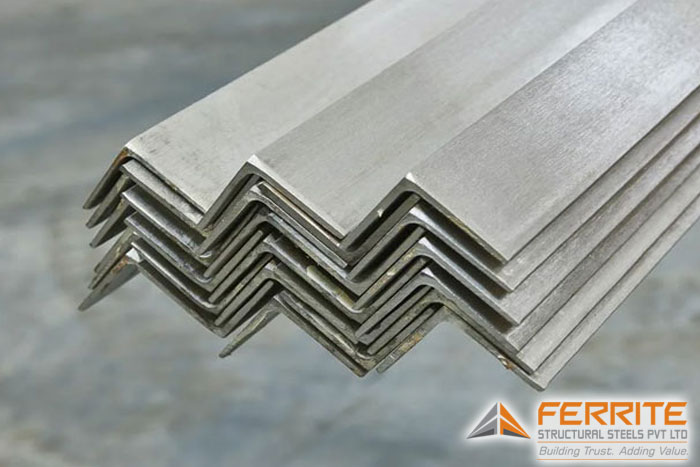
304 Stainless Steel Angle is an L-shaped structural or fabrication section made in grade 304. It is selected for building frameworks, infrastructure, manufacturing supports and architectural elements. The section must still be chosen from the approved drawing or BOQ; the product name alone does not establish load capacity, section modulus or suitability for a particular structure.
02
How does 304 stainless steel angle differ from 304L angle?
304 and 304L have closely related alloy systems, but 304L has a lower-carbon designation commonly preferred for welded fabrication where sensitisation is a concern. Neither should be substituted automatically. The project material specification, welding condition, required properties and end-user approval must control the choice.
03
What sizes are listed for 304 stainless steel angles?
The live page lists 20 x 20 x 3 mm to 200 x 200 x 12 mm for 304 Stainless Steel Angle. Size is normally written as leg dimension x leg dimension x thickness; unequal angles must show the long and short legs in the correct order. Confirm the exact combination, rolling or fabrication route, quantity and tolerance requirement at the enquiry stage.
04
What thickness and length options are stated for 304 angles?
The page states 6 metres, 12 metres, or a reviewed customised length. Length affects handling, transport, cutting allowance and total weight. State whether the order requires random, fixed or exact cut lengths, together with the permitted length tolerance and any cutting drawing. Availability should be confirmed before the BOQ is finalised.
05
Is 304 angle suitable for general outdoor use?
304 stainless steel angle is widely considered for general outdoor and atmospheric exposure, but suitability depends on the actual environment. Salt deposition, industrial chemicals, crevices, surface contamination and maintenance can change corrosion performance. For a structural or safety-critical installation, obtain material approval against the site exposure and approved project specification.
06
Is 304 stainless steel angle suitable for coastal or chloride exposure?
304 stainless steel angle should not be assumed suitable for every coastal or chloride-exposed location. Chloride concentration, wetting, temperature, crevices and cleaning frequency can increase pitting risk. Compare 304 with molybdenum-bearing alternatives through the responsible material engineer, and use the grade approved in the drawing, BOQ or end-user specification.
07
What standard should be specified for a 304 stainless steel angle?
Specify the complete 304 material designation, the material standard, dimensional or section standard, size, thickness, length and required tolerance. A grade standard controls chemistry and mechanical requirements, while a dimensional standard controls geometry and rolling tolerances. The purchase order should identify both where the project requires them.
08
Can another stainless grade be treated as equivalent to 304?
No. An equivalence table is a cross-reference aid, not automatic approval to substitute material. For 304 Stainless Steel Angle, compare the complete chemistry, mechanical properties, heat treatment or supply condition, product standard and dimensional requirements. Any grade change must be accepted by the responsible engineer, consultant or end user before supply.
09
How should 304 angle weight per metre be checked?
Use the published size or weight chart as an initial reference, then verify the theoretical or actual mass for the exact section and applicable standard. Weight per metre changes with both leg dimensions, thickness, corner radii and permissible rolling tolerances. For commercial settlement, confirm the agreed basis of weight in the supplier quotation.
10
What is the 304 stainless steel angle price per kg?
There is no reliable fixed current 304 Stainless Steel Angle price per kg because alloy surcharges, section size, quantity, finish, length and market date change the quotation. Send the exact section, grade, standard, total quantity, documentation and delivery postcode for a dated price. Also confirm whether GST, freight, cutting and inspection are included.
11
Can I get a dated 304 angle price per tonne?
Yes, a dated 304 Stainless Steel Angle price per tonne can be requested for a defined requirement. Quote requests should state the size, thickness, length, grade, standard, total tonnage, finish, MTC and delivery location. Compare suppliers on the same tax, freight, weight and documentation basis rather than comparing only the headline tonne rate.
12
What affects the landed cost of 304 stainless steel angle?
304 Stainless Steel Angle pricing is affected by stainless alloy input costs, grade, section mass, size availability, order quantity, length, finish, cutting, testing, inspection, packing and destination. A small mixed-size order may have a different conversion and logistics cost from one repetitive bulk size. Request dated, like-for-like commercial terms.
13
What is the MOQ for 304 stainless steel angles?
The page states a minimum order quantity of 1 tonne. MOQ may need confirmation where the order mixes sizes, asks for uncommon lengths, special finishes, inspection or export packing. Send the piece count and total tonnage by size so the commercially workable quantity can be reviewed accurately.
14
Is every 304 angle size available immediately?
Do not assume every 304 Stainless Steel Angle size, thickness, grade and length is available immediately. Availability should be confirmed for the exact specification and quantity on the enquiry date. If timing is critical, include the required delivery date and ask the quotation to identify stock, mill supply or production basis clearly.
15
Can 304 stainless steel angles be supplied with an MTC?
An MTC requirement should be stated when requesting 304 Stainless Steel Angle. Specify the required certificate type, heat or batch traceability and any project-specific format before ordering. The supplied documentation should be checked against the purchase order; do not assume that a generic certificate proves compliance with every project standard.
16
What should a buyer verify on a 304 angle test certificate?
Inspection should cover section dimensions, thickness, length, straightness, surface condition, marking and quantity against the purchase order. For 304 Stainless Steel Angle, also verify grade identification and traceability to the requested MTC. If third-party inspection is required, name the agency, inspection stage, acceptance criteria and document set in the enquiry.
17
Can 304 angles be cut, drilled and welded?
304 Stainless Steel Angle can be considered for welded fabrication, with the grade selected for general corrosion resistance and broad fabrication use. State the welding process, filler requirement, joint detail, service temperature, post-weld treatment and applicable procedure specification. Welding qualification and final acceptance remain the responsibility of the fabricator and project engineer.
18
Where are 304 stainless steel angles commonly used?
Common buyer applications include building frameworks, infrastructure, manufacturing supports and architectural elements. Suitability depends on grade, section properties, exposure, temperature, connection design and maintenance. For load-bearing work, the final angle size and grade must follow approved calculations, drawings, BOQ and the governing project standard.
19
Can I buy 304 stainless steel angles in Mumbai or Navi Mumbai?
Buyers searching for a 304 Stainless Steel Angle supplier in Mumbai, Navi Mumbai or Maharashtra can send the full requirement to Ferrite for review. India-wide or export supply should be checked against quantity and logistics. Include the delivery postcode or destination port, unloading constraints, required date and commercial delivery term.
20
What details are required for a fast 304 angle quotation?
For a fast 304 Stainless Steel Angle quotation, provide profile, leg dimensions, thickness, grade, standard, length, piece quantity, total tonnage, finish, make preference, MTC and inspection requirements. Add fabrication drawings, delivery postcode or destination port, Incoterm and required date where applicable. This prevents price comparisons based on incomplete or different specifications.